
Microchip PIC18LF6722-I 8-Bit Microcontroller: Architecture, Features, and Application Design Considerations
The Microchip PIC18LF6722-I represents a robust and versatile member of the enhanced PIC18 family, designed to deliver high performance for complex embedded applications. Its architecture and feature set make it particularly suitable for demanding tasks in industrial control, automotive systems, and advanced consumer electronics where low-power operation and computational power are paramount.
Architecture Overview
At its core, the PIC18LF6722-I is built upon an enhanced Harvard architecture with a 16-bit wide instruction set. This design allows for simultaneous access to program and data memory, significantly boosting throughput. The microcontroller operates at speeds up to 40 MHz, executing most instructions in a single clock cycle (200 ns instruction cycle), resulting in a performance of up to 10 MIPS.
A key architectural component is its 128 KB of Flash program memory and 3,808 bytes of RAM. This substantial memory space is essential for supporting larger application codes and complex data handling, often required in sophisticated embedded systems. The inclusion of a 31-level deep hardware stack ensures reliable handling of subroutine calls and interrupts.
Key Features and Capabilities
The PIC18LF6722-I is packed with peripherals that reduce system component count and simplify design:
Low-Power Management: The "LF" variant is specified for operation over an extended voltage range (2.0V to 5.5V), making it ideal for battery-powered and energy-sensitive applications. It features multiple power-saving modes (Idle, Sleep) and a flexible clocking structure.
Analog Integration: It includes a high-performance 10-bit Analog-to-Digital Converter (ADC) with up to 12 input channels, enabling direct interfacing with a multitude of sensors without external components.
Communication Interfaces: A rich set of serial communication modules is available, including EUSART (for RS-232/485), SPI, and I2C ports. This allows for seamless connectivity with peripherals like sensors, memory chips, displays, and other microcontrollers.
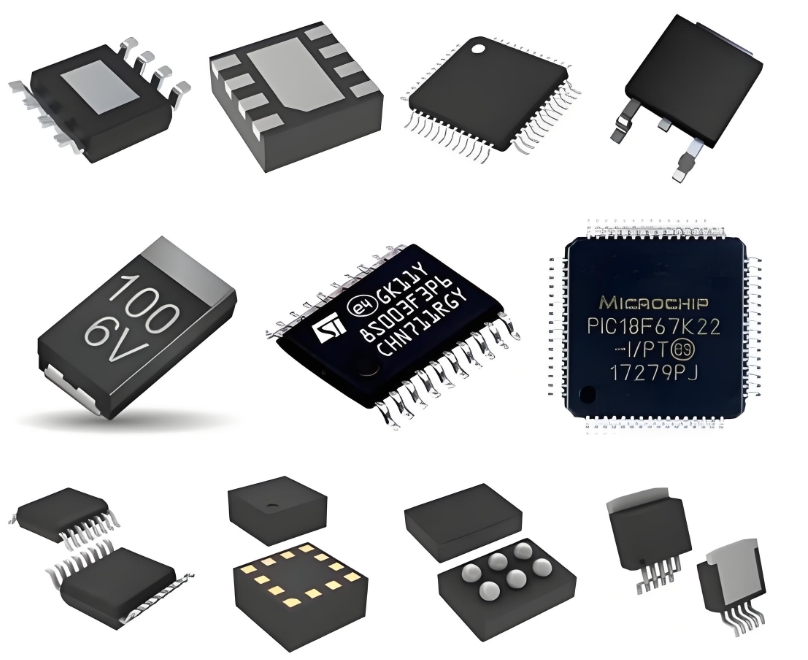
Timing and Control: With multiple timers/counters (including a 4x PWM module), the device excels at generating precise waveforms for motor control, power conversion, and measuring external events.
Application Design Considerations
Designing with the PIC18LF6722-I requires careful planning to leverage its full potential:
1. Power Supply Decoupling: Due to its high-speed operation, proper decoupling with ceramic capacitors (e.g., 0.1μF) placed close to the VDD and VSS pins is critical to ensure stable operation and minimize noise.
2. Clock Source Selection: The choice between a crystal oscillator, external RC, or internal oscillator block depends on the application's need for precision and cost. For timing-critical applications like serial communication, a crystal oscillator is recommended for accuracy.
3. Peripheral Interrupt Management: With numerous peripheral interrupt sources, developing a logical and efficient interrupt service routine (ISR) hierarchy is vital to maintain responsive and deterministic system behavior.
4. Low-Power Optimization: To maximize battery life, designers should strategically use the SLEEP and IDLE modes, shutting down unused peripherals and leveraging the internal oscillator to minimize active power consumption.
5. Analog Design: When using the ADC, ensure a stable reference voltage and consider the impedance of the signal source. Proper PCB layout is necessary to separate analog and digital grounds to avoid noise coupling into sensitive analog measurements.
ICGOOODFIND
The Microchip PIC18LF6722-I is a powerful and highly integrated 8-bit microcontroller that strikes an impressive balance between computational performance, peripheral integration, and low-power operation. Its extensive memory and versatile I/O capabilities make it a formidable choice for designers tackling complex embedded system challenges across a wide range of industries.
Keywords: PIC18LF6722-I, Harvard Architecture, Low-Power, Analog-to-Digital Converter (ADC), Embedded Systems

